Last Updated on July 11, 2026 by Melissa
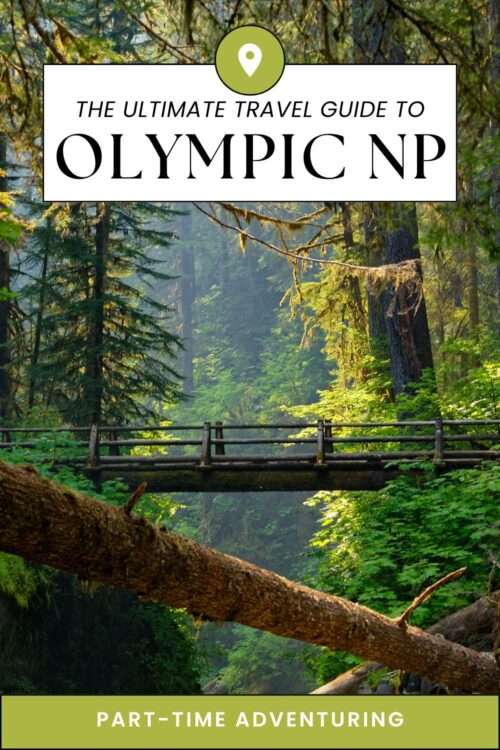
Olympic National Park packs three completely different ecosystems into one 922,000-acre park: a 73-mile wild Pacific coastline, a temperate rainforest that gets up to 170 inches of rain a year, and a glaciated mountain core you can drive to in under an hour from sea level. No road crosses the park’s interior, so you’ll approach it in sections — a ring of spur roads branching off Highway 101, each one dropping you into a completely different world.
We’ve spent time in the park’s main areas — the beaches, Lake Crescent, Hurricane Ridge, and the Hoh Rainforest — and this guide walks through those plus the quieter corners of the park, with current 2026 fees, the hikes worth your time, and where to base yourself.
Some of the links on this website are affiliate links, which means we may earn a small commission if you make a purchase through them — at no additional cost to you. These commissions help support Part Time Adventuring and allow us to continue creating free travel guides, national park itineraries, hiking resources, and adventure content.
Table of Contents
- Overview: Three Parks in One
- Best Time to Visit
- Entrance Fees & Permits (2026)
- Getting There & Getting Around
- The Beaches
- The Hoh Rainforest
- Hurricane Ridge
- Lake Crescent
- Sol Duc Hot Springs
- Lake Quinault & the Southern Rainforest
- Beyond the Frontcountry: Ozette
- Top Hikes at a Glance
- What to Pack
- Wildlife You Might See
- Where to Stay
- A Sample 3-Day Itinerary
- FAQ
Olympic National Park: Three Parks in One
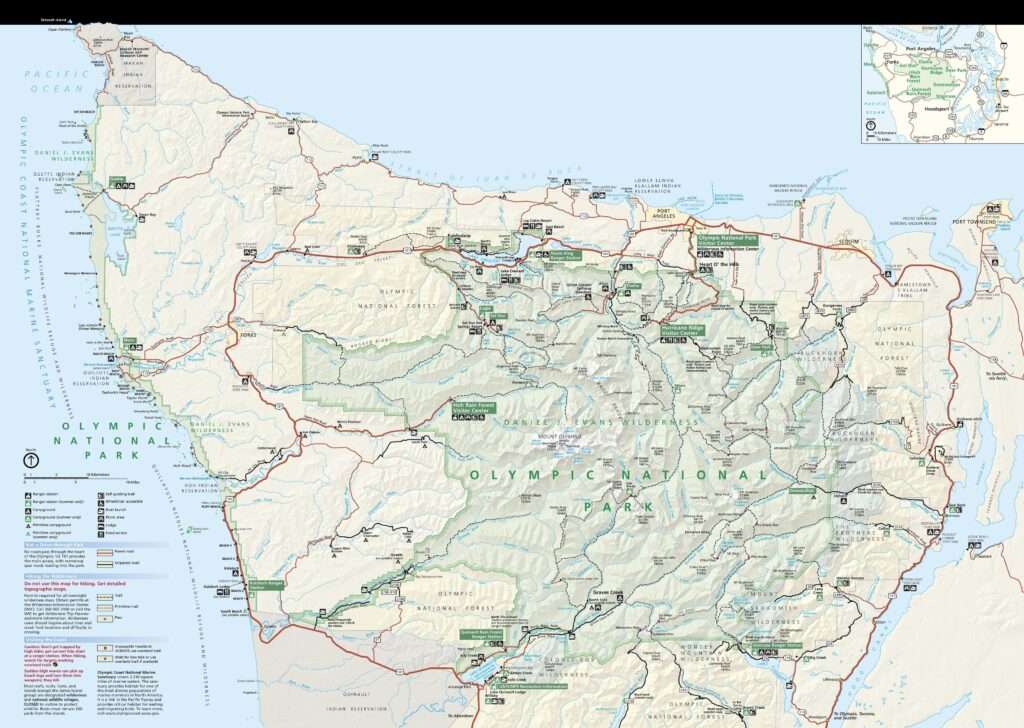
Most first-time visitors are surprised that Olympic National Park doesn’t feel like one park — it feels like three. The west side holds the rainforest valleys (Hoh, Quinault, and Queets), the Pacific coast runs along the park’s western edge with sea stacks and tide pools, and the interior climbs to a glaciated mountain core topped by Mount Olympus at 7,980 feet, ringed by more than 250 glaciers. Because no road crosses the middle of the park, you’ll drive the perimeter on Highway 101 and turn onto spur roads to reach each section. Most visitors pick two or three areas to combine over a long weekend rather than trying to see everything in one trip.
Olympic was designated a national park in 1938 and later became a UNESCO World Heritage Site and Biosphere Reserve, recognition of just how unusual it is to find rainforest, coastline, and alpine terrain protected inside a single boundary. That range is exactly what makes it hard to plan for — the packing list, the driving times, and even the best season to visit all shift depending on which part of the park you’re headed to.
Best Time to Visit Olympic National Park
Olympic changes dramatically by season, and what’s open shifts along with it — here’s what to expect and plan around in each.
Spring (March–May) is when the park starts waking up. Sol Duc Hot Springs Resort reopens in late March, waterfalls run high on snowmelt, and the rainforest is at its greenest. Hurricane Ridge Road typically returns to daily access by April, though higher trails can still hold snow into May or June. Crowds are light and rain is common, but it’s a good window for tide pools and for beating the summer lines at the Hoh.
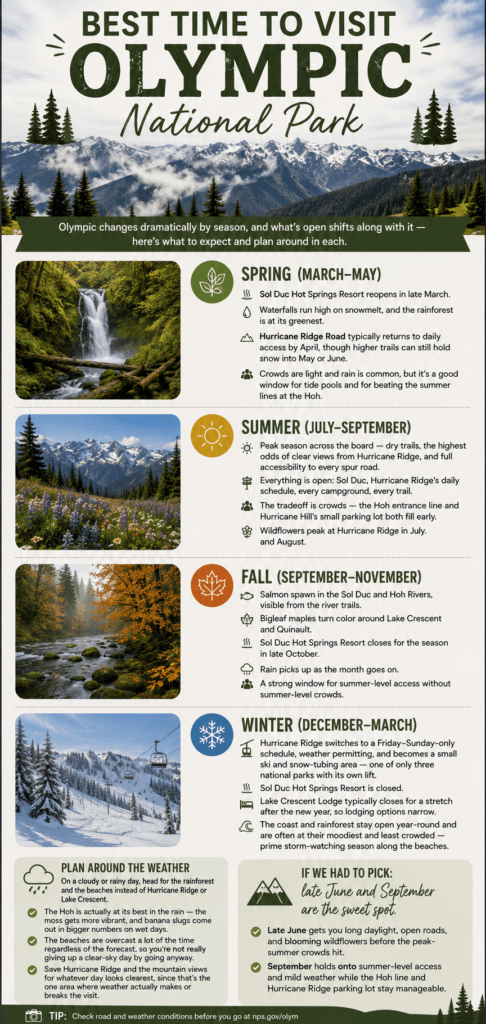
Summer (July–September) is peak season across the board — dry trails, the highest odds of clear views from Hurricane Ridge, and full accessibility to every spur road. It’s also when everything is open at once: Sol Duc, Hurricane Ridge’s daily schedule, every campground, every trail. The tradeoff is crowds — the Hoh entrance line and Hurricane Hill’s small parking lot both fill early, and wildflowers peak at Hurricane Ridge in July and August if that’s part of the draw.
Fall (September–November) brings the crowds back down fast after Labor Day. Salmon spawn in the Sol Duc and Hoh Rivers, visible from the river trails, and bigleaf maples turn color around Lake Crescent and Quinault. Sol Duc Hot Springs Resort closes for the season in late October, and rain picks up as the month goes on. It’s a strong window if you want summer-level access without summer-level crowds.
Winter (December–March) turns the park into something else entirely. Hurricane Ridge switches to a Friday–Sunday-only schedule, weather permitting, and becomes a small ski and snow-tubing area — one of only three national parks with its own lift. Sol Duc Hot Springs Resort is closed, and Lake Crescent Lodge typically closes for a stretch after the new year, so lodging options narrow. The coast and rainforest stay open year-round and are often at their moodiest and least crowded — this is prime storm-watching season along the beaches, though conditions can turn rough with little warning.
If your trip spans multiple days, plan around the weather rather than fighting it. On a cloudy or rainy day, head for the rainforest and the beaches instead of Hurricane Ridge or Lake Crescent. The Hoh is actually at its best in the rain — the moss gets more vibrant, and banana slugs come out in bigger numbers on wet days. The beaches are overcast a lot of the time regardless of the forecast, so you’re not really giving up a clear-sky day by going anyway. Save Hurricane Ridge and the mountain views for whatever day looks clearest, since that’s the one area where weather actually makes or breaks the visit.
If we had to pick: late June and September are the sweet spot. Late June gets you long daylight, open roads, and blooming wildflowers before the peak-summer crowds hit. September holds onto summer-level access and mild weather while the Hoh line and Hurricane Ridge parking lots thin out after Labor Day.
Entrance Fees & Permits (2026)
Olympic National Park charges a standard entrance fee like most major parks, but it’s one of the parks not on the list that charges the new $100 nonresident surcharge — non-U.S. residents pay the same rate as everyone else here.

- 7-day private vehicle pass: $30
- 7-day per-person pass (foot, bike, no vehicle): $15
- Motorcycle pass: $25
- Olympic annual pass: $55
- America the Beautiful annual pass: $80 (U.S. residents) / $250 (non-U.S. residents) — covers Olympic and every other fee-charging national park for a year
- Wilderness camping permit: $8 per person per night, plus a $6 flat permit fee, required for any overnight backcountry trip
- Developed campground fees: $15–$24/night depending on location and season
- Sol Duc Hot Springs day-use pool access: $19/adult, $15/child or senior, per 90-minute session — separate from the entrance fee, which still applies
If your 2026 travel plans include more than two or three fee-charging parks, the America the Beautiful pass pays for itself fast — we cover the math in more detail in our guide to the America the Beautiful Pass.
Getting There & Getting Around
Most visitors fly into Seattle-Tacoma International Airport and drive from there — it’s about a 2.5 to 3-hour drive to Port Angeles, depending on whether you take the I-5/Highway 101 route around Puget Sound or catch a ferry across. The Coho ferry from Victoria, B.C. to Port Angeles is also a popular add-on if you’re combining Olympic National Park with a Vancouver Island trip.
Port Angeles is the main gateway on the north side of the park and the base for Hurricane Ridge and Lake Crescent. Forks sits on the west side and is your best base for the rainforest and the La Push-area beaches. There’s no road through the park’s interior, so plan your route as a loop around the perimeter on Highway 101 rather than a straight shot from one area to another — Rialto Beach and Hurricane Ridge, for example, are roughly two hours apart by road even though they’re both “in” Olympic.
A rental car is essentially required. There’s no shuttle system connecting the park’s different areas, cell service is spotty to nonexistent once you’re off Highway 101, and several of the spur roads (Hurricane Ridge Road in particular) are winding enough that you’ll want to budget more driving time than Google Maps suggests, especially with an RV or trailer.
The Beaches
Olympic’s coastline doesn’t look like a typical beach vacation — think massive sea stacks, driftwood the size of small buildings, and cold, moody Pacific water rather than sand and umbrellas.
Ruby Beach was our favorite of the two we spent real time at. It’s a short walk down from the bluff-top parking lot, and the rounded river-stone beach with sea stacks just offshore makes it one of the most photogenic stops on the whole coast.
Rialto Beach is bigger and easier to access — no hike from the parking lot to the water. The signature hike here is the 3.3-mile round-trip walk north to Hole-in-the-Wall, a natural sea arch with tide pools around its base. This one only works at low tide — check a tide chart before you go, and give yourself a real buffer. We didn’t time it right on our visit and skipped the hike rather than risk getting caught by the incoming water, which is exactly what the park service recommends if you’re not sure.
Kalaloch and Beach 4 are the most accessible beaches in the park and generally considered the best spot for tide pooling — sea stars, anemones, and hermit crabs are common at low tide. Both Kalaloch and Ruby Beach are pet-friendly, which isn’t true of Second, Third, or Ozette.
Near La Push, Second Beach and Third Beach are both reached by a short forest hike rather than a drive-up parking lot, which keeps them a little quieter than Rialto or Ruby. Second Beach is the more popular of the two, with sea stacks just offshore and a wide, easy-to-walk stretch of sand; Third Beach is quieter, stretches farther south, and adds a payoff waterfall — Third Beach Falls — at its far end. Neither allows pets.
Tide pool safety note: walk on sand or bare rock rather than on the pools themselves, never touch marine life, and always check a tide chart before committing to a beach hike.
The Hoh Rainforest
The Hoh Rainforest gets up to 170 inches of rain a year, making it one of the wettest spots in the continental U.S. — and it shows, in moss-draped maples and Sitka spruce that make the whole valley feel prehistoric. The Hall of Mosses (0.8 miles) and Spruce Nature Trail are the two short, easy loops most visitors do from the Hoh Visitor Center, and both are worth the drive even if you only have an hour.
One thing to plan around: the Hoh entrance road can back up badly in summer, with wait times reported as long as two to three hours on peak weekends. Arrive early (before 8am) morning or later in the afternoon (after 5) if you can.
Planning a rainforest day? We wrote a full breakdown of the Hoh — trail options, timing, and what to expect — in 10 Things You Need to Know Before Visiting the Hoh Rainforest.
Hurricane Ridge
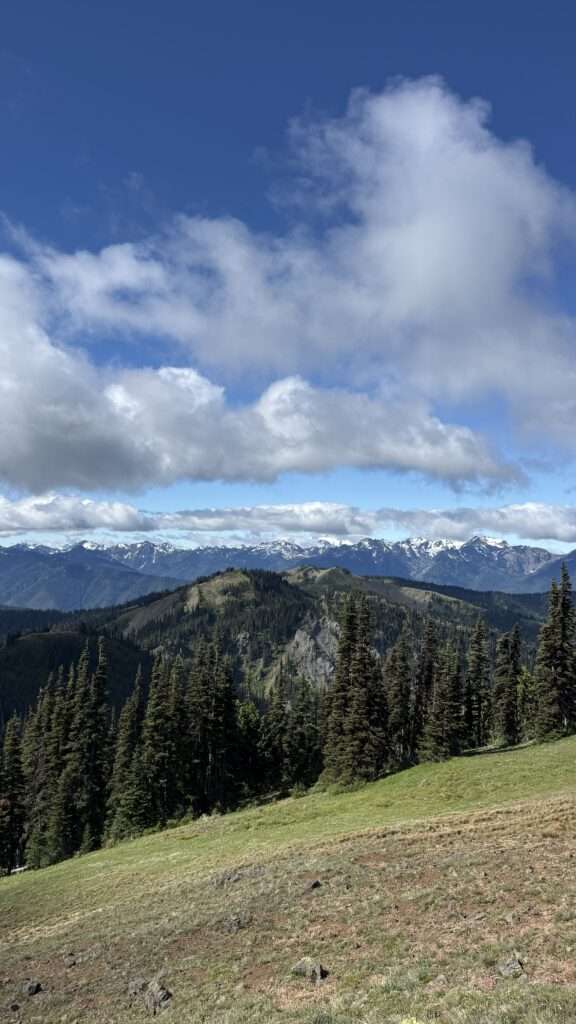
Hurricane Ridge is the most accessible high-elevation viewpoint in the park — an 18-mile, roughly 45-minute drive from Port Angeles takes you from sea level to 5,242 feet. On a clear day you get sweeping views of the interior Olympic Mountains and the Strait of Juan de Fuca, and it’s genuinely one of the better wildlife-viewing spots in the park — deer and marmots are common right along the trails and even the parking lot.
The Hurricane Ridge Day Lodge burned down in 2023, so there’s currently no indoor visitor center — just temporary trailers with restrooms and a contact station. Dress for weather regardless of the forecast; conditions change fast at elevation. In 2026, the ridge is open daily through summer, with some weekday closures in June for utility work, and it reverts to a Friday–Sunday-only winter schedule from December through March.
Check the webcam before you drive up. The NPS runs a live Hurricane Ridge webcam, and it’s worth a look before committing to the trip — clouds up there move in and out fast, sometimes clearing in under an hour. If it looks socked in when you check, that’s not necessarily the final answer; if you’re already on your way or already there, it’s often worth waiting it out rather than turning around, since the sky can open up with little warning.
The Hurricane Hill Trail (3.2 miles round-trip, paved) is the standout hike here — 360-degree mountain views for a moderate effort, though the small parking lot fills early.
Lake Crescent
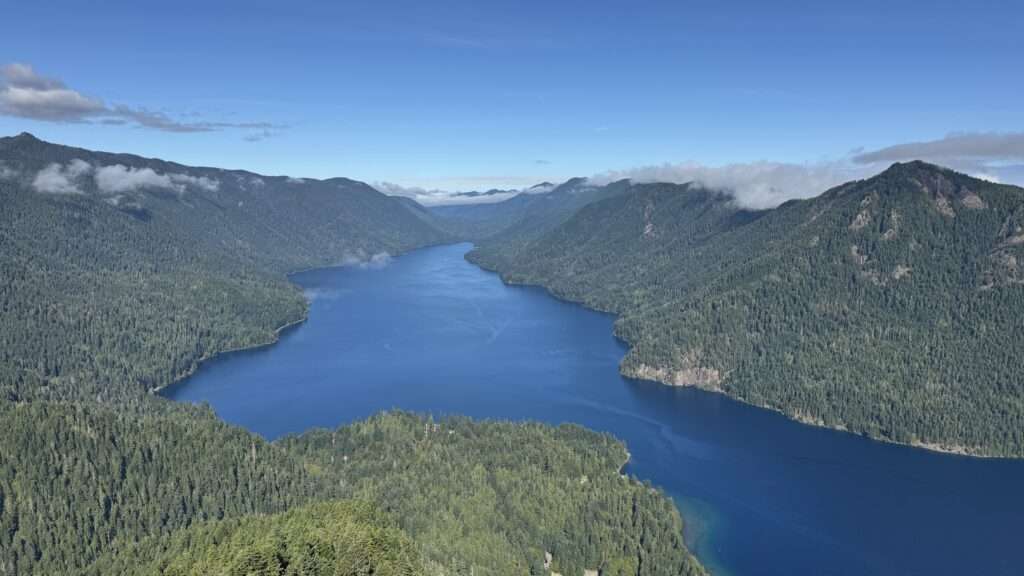
Lake Crescent is a glacially carved lake so clear you can see roughly 50 feet down in places, and it’s one of the busier stops in the park thanks to its proximity to Port Angeles.
We hiked Mount Storm King, and it’s one of the most memorable trails in the park — but it’s not for everyone. It’s a steep, roughly 2-mile climb with a section of fixed ropes near the top and real exposure on the way up. Only attempt it if you’re in good shape and comfortable with heights. The reward is one of the best lake views in Olympic, looking straight down onto Crescent’s blue water.
If Storm King isn’t your speed, Marymere Falls shares the same trailhead and is an easy 1.8-mile round trip through old-growth forest to a 90-foot waterfall — genuinely one of the more accessible “wow” hikes in the park. The Spruce Railroad Trail is a flat, paved 4-mile (up to 11.2-mile round trip) option along the lake’s north shore, good for families or anyone wanting lake views without elevation gain — it also passes Devil’s Punchbowl, a swimming spot popular enough to get crowded on hot afternoons.
Sol Duc Hot Springs
A short drive further into the valley from Lake Crescent, Sol Duc Hot Springs is the only developed hot springs inside the park, and one of the few in any national park in the Pacific Northwest. Three mineral pools (98–104°F) plus an unheated freshwater pool sit on a timber deck surrounded by old-growth forest — genuinely one of the better ways to end a day of hiking.
The resort operates seasonally, late March through late October, and closes for winter. Day-use pool access runs in 90-minute sessions and costs $19 for adults and $15 for children (4–12) and seniors (62+) as of 2026 — on top of the standard park entrance fee, which still applies even if you’re only there to soak. Book ahead if you can; sessions can sell out on summer weekends, and towel rental is $5 if you don’t bring your own.
Sol Duc is also the trailhead for Sol Duc Falls — an easy 1.6-mile round trip through old-growth forest to a photogenic multi-channel waterfall, and one of the more natural hike-then-soak pairings in the park if you’re staying at the resort for the night.
Lake Quinault & the Southern Rainforest
Lake Quinault sits at the park’s southwest corner and gets skipped by a lot of visitors simply because of geography — it’s roughly three hours from Port Angeles, closer to Aberdeen and the southern approach off Highway 101 than to the rest of the loop. That distance is also why it’s less crowded than the Hoh.
The historic Lake Quinault Lodge — celebrating its 100th anniversary in 2026, and where FDR reportedly ate dinner during the 1937 visit that helped convince him to establish the park the following year — anchors the area, and the Quinault Rain Forest around it holds some of the park’s biggest trees, including the world’s largest Sitka spruce. The Quinault Rainforest Nature Loop is an easy walk near the lodge, and the roughly 31-mile Quinault Loop Drive circles the lake past Merriman Falls and several other roadside waterfalls — budget about two hours, and expect a stretch of gravel road on the north shore.
Because of the drive time, Quinault works best as its own stop rather than something you squeeze into a northern-loop itinerary — pair it with the southern beaches if you’re approaching from Olympia or Aberdeen, or treat it as an extra day if you have one to spare.
Beyond the Frontcountry: Ozette
If you want a taste of Olympic National Park’s wilderness coast without a multi-day backpacking trip, the Ozette Loop is the one to know about. It’s a 9.3-mile triangle hike starting and ending at Lake Ozette, with boardwalk trail through forest on both legs and a coastal stretch in between that passes ancient petroglyphs at Wedding Rocks. It’s a full day, more remote than the beaches covered above, and — like everything on this coast — best timed around low tide. Camping is allowed with a wilderness permit if you’d rather turn it into an overnight.
Top Hikes in Olympic National Park at a Glance
Look at AllTrails top picks here
- Hall of Mosses (Hoh Rainforest) — 0.8 mi, easy
- Hurricane Hill (Hurricane Ridge) — 3.2 mi round trip, moderate, paved
- Marymere Falls (Lake Crescent) — 1.8 mi round trip, easy
- Sol Duc Falls (Sol Duc Valley) — 1.6 mi round trip, easy
- Mount Storm King (Lake Crescent) — ~4 mi round trip, strenuous, fixed ropes, not for those afraid of heights
- Spruce Railroad Trail (Lake Crescent) — up to 11.2 mi round trip, easy, flat and paved
- Rialto Beach to Hole-in-the-Wall — 3.3 mi round trip, easy, low tide only
- Quinault Rainforest Nature Loop (Lake Quinault) — easy, family-friendly
- Ozette Loop (Lake Ozette) — 9.3 mi loop, moderate, boardwalk and coastal terrain, low tide recommended
What to Pack for Olympic National Park

Olympic’s three ecosystems mean you’re realistically packing for three different climates in one trip. Layers are non-negotiable — Hurricane Ridge can be 30 degrees colder and windier than the coast on the same day. A few essentials worth calling out specifically for this park: waterproof (not just water-resistant) footwear for the rainforest trails, which stay muddy even in summer; a real rain shell, since Pacific Northwest weather shifts fast; and a printed tide chart or an offline tide app for the coast, since cell service disappears well before you reach most of the beach trailheads.
Wildlife You Might See in Olympic National Park
Olympic National Park has healthy populations of Roosevelt elk, black-tailed deer, and black bear, plus marmots and mountain goats at higher elevations around Hurricane Ridge. Deer and marmots are common enough along the Hurricane Ridge trails that sightings are close to guaranteed on a clear day. Along the coast, watch the tide pools for sea stars and anemones, and keep an eye on the water — gray whales and sea lions are regularly spotted from the beaches and bluffs, especially during spring migration. As with any national park, keep a safe distance and never feed wildlife, even animals that seem used to people. For more parks known for wildlife encounters, see our guide to the Best National Parks to See Wildlife.
Where to Stay When Visiting Olympic National Park
One decision worth making early: split your stay between Port Angeles and Forks, or keep one base and accept early mornings. Splitting it cuts daily drive time roughly in half, but locks you into being on one side of the park each day — less room to chase a clear day at Hurricane Ridge if the weather shifts. One base costs more drive time (plan on 5:30–6 a.m. starts for the Hoh or a low-tide beach) but keeps every part of the park within reach if plans change.
- Lake Crescent Lodge — historic lodge right on the lake, a great base for Marymere Falls and Mount Storm King
- Sol Duc Hot Springs Resort — cabins near the hot spring pools, a solid midpoint base for Lake Crescent and the rainforest
- Kalaloch and the coast — lodging options near Kalaloch, including Kalaloch Lodge, put you steps from the beach
- Port Angeles — the largest town on the peninsula and the most practical base for Hurricane Ridge and Lake Crescent, with the widest range of hotel options
- Forks — best positioned for the Hoh Rainforest and the La Push-area beaches
- Lake Quinault Lodge — the historic option in the park’s southwest corner, best if you’re approaching from Olympia or Aberdeen rather than doing the northern loop
Camping: If you’re road-tripping or pulling an RV, Olympic has developed campgrounds in each major area — Kalaloch Campground on the coast, Mora near Rialto Beach, Sol Duc near the hot springs, and Fairholme on the west end of Lake Crescent are the most popular. All run $15–$24/night, and Kalaloch and Sol Duc both take reservations in summer rather than running first-come, first-served — book those well ahead if you’re set on a specific site.
A Sample 3-Day Olympic National Park Itinerary
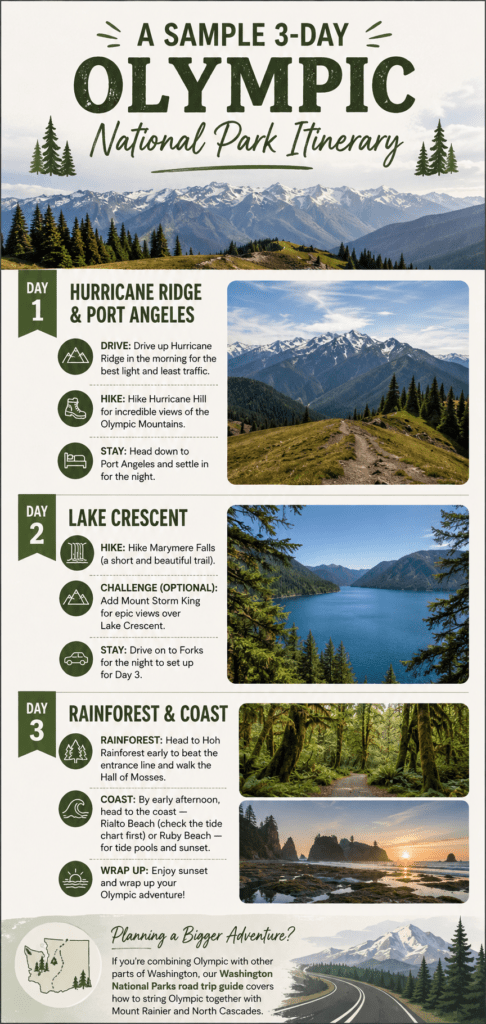
Day 1 — Hurricane Ridge & Port Angeles: Drive up Hurricane Ridge in the morning for the best light and least traffic, hike Hurricane Hill, and settle into Port Angeles for the night.
Day 2 — Lake Crescent: Hike Marymere Falls, and if you’re up for a challenge, add Mount Storm King. Drive on to Forks for the night to set up for Day 3.
Day 3 — Rainforest & Coast: Head to the Hoh Rainforest early to beat the entrance line and walk the Hall of Mosses. By early afternoon, head to the coast — Rialto Beach (check the tide chart first) or Ruby Beach — for tide pools and sunset before wrapping up the trip.
If you’re combining Olympic with other parts of Washington, our Washington National Parks road trip guide covers how to string Olympic together with Mount Rainier and North Cascades.
FAQ
Do I need a reservation to enter Olympic National Park? No timed-entry reservation system is currently required at Olympic — you just need a valid entrance pass, purchased online or at the gate.
How many days do you need for Olympic National Park? Three to four days is enough to see the highlights across the park’s core areas — the coast, Lake Crescent, Hurricane Ridge, and the Hoh Rainforest. If you only have one or two days, pick two adjacent areas rather than trying to cover the whole park, and treat Lake Quinault and Ozette as bonus stops for a longer trip.
Is Hurricane Ridge open in 2026? Yes, daily through summer with some scattered weekday closures in June for utility work, and weekends-only from December through March. There’s no indoor visitor center since the 2023 fire, so plan accordingly for weather.
Can I bring my dog to Olympic National Park? Pets are allowed at Kalaloch and Ruby Beach and on part of Rialto Beach, but not on Second Beach, Third Beach, or most trails in the park’s interior, including Hoh Rainforest trails.
What’s the best beach in Olympic National Park? It depends what you’re after — Ruby Beach for scenery and sea stacks, Kalaloch’s Beach 4 for tide pooling, and Rialto for the Hole-in-the-Wall hike (low tide only).
Do I need a permit to hike in Olympic National Park? Day hikes on established trails just require your entrance pass. Overnight backcountry trips require a Wilderness Camping Permit at $8 per person per night plus a $6 permit fee.
When is low tide at the Olympic beaches? Tide times shift daily, so check a current NOAA tide chart for the Kalaloch or La Push area before you go rather than relying on a general rule. Aim to arrive at least 30 minutes before the listed low tide time to get the most exposed tide pools and the safest window for any beach hike, like Rialto’s Hole-in-the-Wall.
How much does it cost to soak at Sol Duc Hot Springs? Day-use pool access is $19 for adults and $15 for children and seniors per 90-minute session as of 2026, on top of the park entrance fee. Pool access is included if you’re staying overnight at the resort.