Last Updated on October 27, 2026 by Melissa
White Sands National Park protects the largest gypsum dunefield in the world: 275 square miles of white sand in southern New Mexico’s Tularosa Basin. It’s also one of the easiest national parks to fit into a road trip. One road, a handful of short trails, and sledding down 60-foot dunes fill a half day. Staying through sunset fills a full one.
There are a few things to know before you go. The park sits inside an active missile range, so tests sometimes close the road. A safety corridor has shut part of Dunes Drive since 2024, and backcountry camping is suspended. We visited in spring and drove in right as the gate opened at 7 a.m. This guide covers what’s open right now, the best time to visit, which trails to hike, how sledding works, and where to stay.
Some of the links on this website are affiliate links, which means we may earn a small commission if you make a purchase through them — at no additional cost to you. These commissions help support Part Time Adventuring and allow us to continue creating free travel guides, national park itineraries, hiking resources, and adventure content.
Table of Contents
- White Sands at a Glance
- Entrance Fees and Hours
- Missile Testing Closures
- Best Time to Visit White Sands
- Driving Dunes Drive
- Best Hikes at White Sands
- Sledding at White Sands
- Ranger Programs and the Lake Lucero Tour
- How Much Time Do You Need?
- How to Get to White Sands
- Where to Stay Near White Sands
- Rules and Tips Before You Go
- What to Do Nearby
- White Sands National Park FAQ
White Sands at a Glance
- Location: US-70 between Alamogordo (about 15 miles) and Las Cruces (about 52 miles), New Mexico
- Entrance fee: $25 per vehicle, good for seven days
- Reservations: None required for park entry
- Hours: Gate opens at 7 a.m. daily and closes 30 minutes after sunset (one hour after sunset in summer). Closed Thanksgiving and Christmas Day.
- Main road: Dunes Drive, eight miles one way
- Camping: No campground. Backcountry camping is currently suspended.
- Water: The visitor center is the only water source
- Cell service: Spotty. Download the NPS app with offline content before you arrive.
Entrance Fees and Hours
According to the NPS, entry to White Sands costs $25 per private vehicle, good for seven days. Motorcycles are $20.
The America the Beautiful Pass covers entry here. It costs $80 for U.S. residents. White Sands is not one of the 11 parks with the $100 nonresident surcharge, so international visitors pay the standard fee.
Related: The Ultimate Guide to the America the Beautiful Pass — the new pricing, the nonresident surcharge, and when the pass pays for itself.
Hours: The gate opens at 7 a.m. every day. It closes 30 minutes after local sunset, so closing time shifts through the year and is earliest in December. From late May through early September, it stays open until one hour after sunset. The NPS notes that local sunset runs about eight minutes earlier than Alamogordo’s predicted time, because the mountains block the sun. The visitor center and gift shop are open 9 a.m. to 5 p.m. year-round. Check the NPS hours page for the current schedule. The park can also close for severe weather; closures are posted on the park’s Facebook page and nmroads.com.
Missile Testing Closures
White Sands is surrounded by White Sands Missile Range, and testing occasionally closes both Dunes Drive and US-70 between Alamogordo and Las Cruces. According to the NPS:
- Closures typically last up to three hours
- All activities along Dunes Drive stop during a test closure
- The visitor center and gift shop stay open during closures
Check the NPS park closures page the day before you go. You can also call the park at (575) 479-6124. If a closure overlaps your visit, plan the visitor center, a picnic, or Alamogordo’s space museum around it.
Best Time to Visit White Sands
Fall (October–November) is the best time to visit White Sands. The NPS describes fall as typically sunny with light winds. Winter is a close second if you dress for cold mornings.
NPS monthly averages (°F):
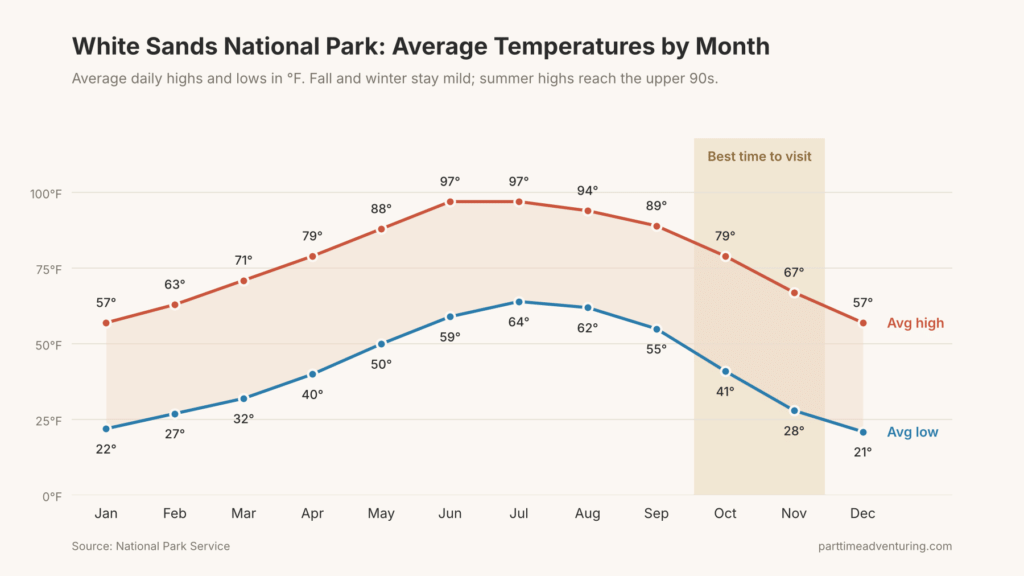
- Winter (December–February): Cold mornings, mild afternoons, and the lowest crowds outside holiday weeks. Snow on the dunes is rare. The Lake Lucero tour runs monthly in this season.
- Spring (March–May): This is when we visited. Spring break is the busiest stretch. Wind is the bigger issue: the NPS reports gusts up to 50 mph, and blowing sand can make hiking miserable or unsafe. When windy the gypsum can hit your pretty hard and hurt.
- Summer (June–August): Highs regularly pass 95°F and have hit 110°F. Monsoon storms bring afternoon lightning from early July to late September. If you visit in summer, hike at sunrise and come back for sunset.
- Fall (September–November): Temperatures drop quickly after September. October and November are the best months for the Alkali Flat Trail.
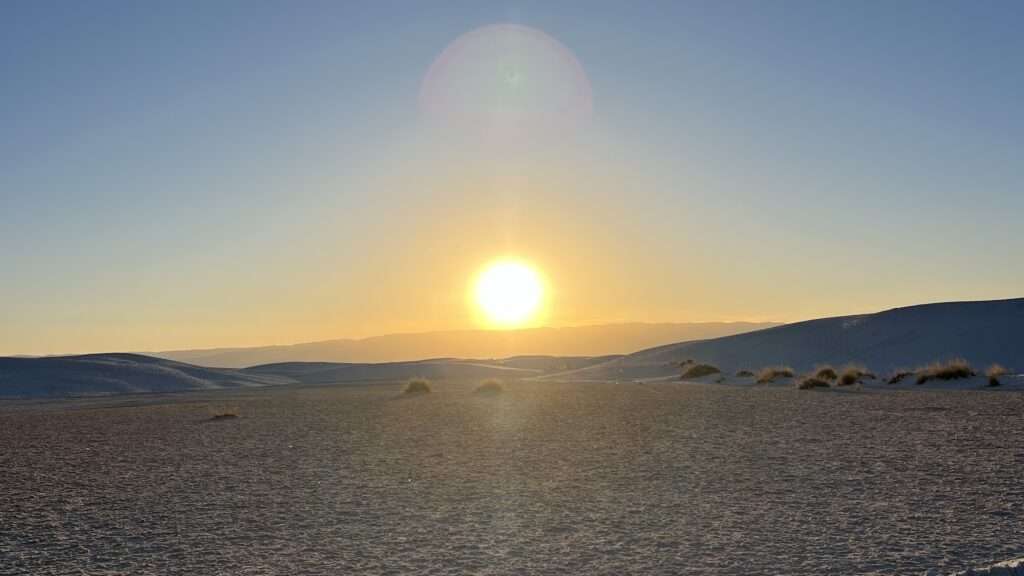
Best time of day: Sunrise and sunset. Low light gives the white dunes shadow and texture; at midday they turn flat and blinding. Sunset is the most popular time, so arrive at least an hour before.
Driving Dunes Drive
Dunes Drive is the park’s only road. It runs eight miles one way (16 miles round trip) from the visitor center into the heart of the dunefield. With no stops, the drive takes about 45 minutes. Roughly the first half is paved. The rest is hard-packed gypsum that handles any passenger car but gets slick after heavy rain.
Current safety corridor: Since an Air Force jet crashed near the road in April 2024, the NPS has kept a safety corridor between mile 3 and mile 5.5. You can drive through, but you can’t stop, park, or get out. The area south of the road, including the Interdune Boardwalk, is closed to foot traffic until further notice.
Past the corridor, the road opens into the loop section. This is where most people sled, picnic, and watch sunset. Three picnic areas, Roadrunner, Primrose, and Yucca, have shade shelters and tables on a first-come, first-served basis. Personal charcoal grills are allowed at picnic areas. Ground fires are not.
Best Hikes at White Sands
White Sands trails are short, but sand walking is slow and the glare is tiring. The dune trails have no shade and no water, so carry more water than you think you need.
Playa Trail
- Distance: 0.5 miles round trip
- Difficulty: Easy, flat
This short loop leads to a playa, a shallow basin that sometimes holds water after rain. It’s the easiest walk in the park and a good first stop near the start of Dunes Drive.
Dune Life Nature Trail
- Distance: 1 mile loop
- Difficulty: Moderate (steep dune climbs)
The Dune Life Nature Trail is a self-guided loop with signs about the animals that live in the dunes, including kit foxes, lizards, and darkling beetles. Look for tracks in the morning before wind wipes them out. It’s the best short trail for families, and it’s also the route the ranger-led Moonlight Hike follows.
Interdune Boardwalk (Currently Closed)
- Distance: 0.4 miles round trip
- Difficulty: Easy, elevated boardwalk, wheelchair and stroller accessible
The Interdune Boardwalk crosses the fragile interdune area and is the park’s accessible trail. It sits inside the safety corridor and is closed until further notice. Check the NPS alerts page before your trip in case it reopens.
Alkali Flat Trail
- Distance: 5 miles round trip
- Difficulty: Strenuous
- Time: About 3 hours
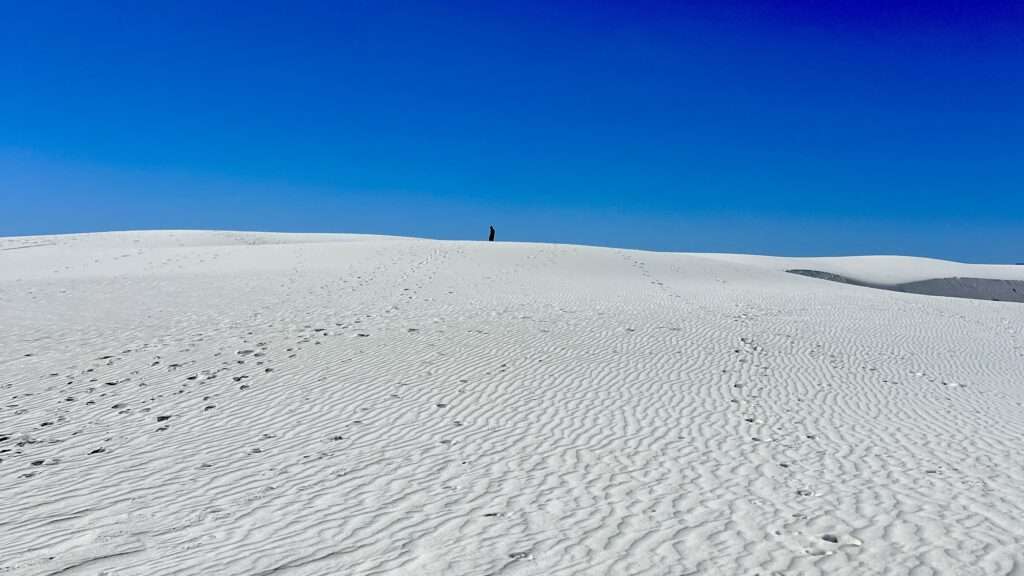
The Alkali Flat Trail is the signature White Sands hike and the only one that takes you deep into the dunefield. It climbs over dune after dune, many around 60 feet tall, to the edge of the dry lakebed that once filled this basin. There’s no path, just red trail markers with a diamond symbol. The trailhead is at the end of Dunes Drive, about seven miles from the visitor center.
The NPS is direct about the risks here, and hikers have died of heat on this trail:
- Don’t start if it’s 85°F or hotter. In summer, start at sunrise or skip it.
- Carry at least one gallon of water per person, and turn back when half is gone.
- Turn back if you can’t see the next marker. Blowing sand can erase the route quickly.
- Tell someone your plan. Cell service is unreliable.
Backcountry Camping Loop
The two-mile backcountry trail and its 10 primitive campsites are normally the only way to spend the night in the park. Backcountry camping is closed with no established reopening date, according to the NPS. If it reopens, permits are issued at the entrance station on a first-come, first-served basis.
Sledding at White Sands
Sledding is the thing most people remember about White Sands. It’s allowed throughout the park except around the Interdune Boardwalk. The NPS points to two spots in particular: the Roadrunner Picnic Area and the Alkali Flat Trailhead, which has some of the tallest dunes in the park.
Getting a sled: According to the NPS, waxed plastic snow saucers work best. You can buy or rent one at the White Sands Trading Company gift shop at the visitor center. The concessioner’s posted prices are $27 to buy a saucer and $17 to rent one, and the last rentals go out two hours before the park closes. Rentals come with a refundable deposit, and wax is sold separately. You can also bring your own saucer, and some Alamogordo hotels lend sleds to guests, so ask when you book.
Tips for better sledding:
- Wax the bottom. Gypsum is grippier than you expect, and an unwaxed saucer barely moves. Rewax every few runs.
- Pick a dune with a gently sloping face and a level runout. The NPS warns that the sand at the base of a dune can be very hard, and sledding injuries are common.
- Go feet first. Sit or lie on the sled with your feet pointing downhill. Don’t sled head first or stand up.
- Check your path. Make sure it doesn’t cross the road or parking areas, and stay away from plants, since they hold the dunes in place.
- Watch young kids closely. The NPS says children ages 5 to 9 are the most likely to get hurt.
Ranger Programs and the Lake Lucero Tour
White Sands runs some of the more unusual ranger programs in the park system. All are seasonal, so check the NPS ranger programs page for current dates.
- Sunset Stroll: A ranger-led walk at sunset, offered on a seasonal schedule.
- Moonlight Hike: Once a month from March through November, on a night around the full moon. A ranger leads the group along the Dune Life Nature Trail in the dark. Tickets cost $8 per adult and $4 for ages 15 and under on Recreation.gov. They go on sale one month ahead at 8 a.m. Mountain Time and often sell out within minutes.
- Full Moon Nights: On full-moon evenings in the warmer months, the park stays open two hours past normal closing, often with live music or a guest program.
- Lake Lucero Tour: Once a month from November through March, on a Saturday at 10 a.m. You meet at the Small Missile Range Gate on US-70, about 25 miles southwest of the park, and caravan in your own car 17.5 miles to Lake Lucero. That’s the dry lakebed where the park’s gypsum originates. From there it’s a 1.5-mile round-trip hike to see selenite crystals. The tour lasts three hours.
Lake Lucero tickets: $8 per adult and $4 for ages 15 and under, on Recreation.gov. Tickets open one month ahead and sell out. Each ticket covers one vehicle, and the tour is capped at 50 people. A few rules to know:
- Closed-toe shoes are required.
- Photos aren’t allowed on missile range property until the ranger says so.
- Bring a full tank and a spare tire. There are no services on the route.
- The park entrance fee doesn’t apply unless you also drive Dunes Drive that day.
The Lake Lucero tour is the best reason to plan a winter visit. It’s the only way to see this part of the basin.
Related: Dark Sky National Parks: The Best Spots for Stargazing — more parks for night skies on a Southwest road trip.
How Much Time Do You Need?
Half a day covers the highlights: Dunes Drive, the Playa and Dune Life trails, and an hour of sledding. A full day adds the Alkali Flat Trail and lets you stay for sunset.
Sample day:
- Morning: Arrive at the 7 a.m. opening, which is what we did. Drive to the end of Dunes Drive and hike Alkali Flat while it’s cool.
- Midday: Picnic in the loop, then visit the visitor center and gift shop and pick up a sled.
- Afternoon: Hike the Dune Life Nature Trail and sled in the loop. Rentals stop two hours before closing.
- Sunset: Pick a dune ridge west of the road and stay until the light goes. The gate closes 30 minutes after sunset outside of summer, so be back at the car in time.
How to Get to White Sands
White Sands is on US-70, about 15 miles southwest of Alamogordo. The closest major airport is El Paso (ELP), about 85 miles away. If you enter “White Sands” into a GPS, you may be routed to White Sands Missile Range instead, so use the park address: 19955 Highway 70 West, Alamogordo, NM.
Approximate drive times:
- Alamogordo: 15 minutes
- Las Cruces: 1 hour (fill your tank before you leave; the nearest gas is in Alamogordo or Las Cruces)
- El Paso, TX: 1.5 hours
- Albuquerque: 3.5 hours
- Carlsbad Caverns National Park: 3.5 to 4 hours
Pairing parks: White Sands pairs naturally with Carlsbad Caverns National Park (see its Big Room) and Guadalupe Mountains National Park on a southern New Mexico and west Texas loop. Plan on half a day of driving between White Sands and Carlsbad Caverns. Guadalupe Mountains is about an hour beyond the caverns, and Big Bend is roughly another five hours south.
Related: The Complete Guide to Big Bend National Park — add it to a winter road trip through the Chihuahuan Desert.
Where to Stay Near White Sands
There’s no lodging or campground inside the park, so you’ll stay in a nearby town.
Alamogordo is the closest base, 15 minutes away, with chain hotels, restaurants, and grocery stores. Being this close makes sunrise and sunset visits easy. Browse Alamogordo hotels on Booking.com.
Las Cruces is an hour away but has many more hotels, better dining, and the historic Mesilla plaza. It’s the better choice if you’re flying into El Paso or continuing west. Browse Las Cruces hotels on Booking.com.
Cloudcroft is a mountain village at about 8,600 feet in the Lincoln National Forest, up the mountain from Alamogordo. It has cabins and much cooler summer temperatures.
Camping: Oliver Lee Memorial State Park, south of Alamogordo at the base of the Sacramento Mountains, has 44 campsites, some with water and electric hookups. According to New Mexico State Parks, developed sites cost $15 a night for New Mexico residents and $20 for nonresidents. Sites with electric hookups cost $20 for residents and $30 for nonresidents. Reservations carry a separate booking fee, and the America the Beautiful Pass isn’t accepted at state parks.
Rules and Tips Before You Go
- Bring water. The visitor center is the only water source. The NPS recommends a gallon per person per day.
- Wear sunglasses and sunscreen. The gypsum reflects sunlight back up at you.
- Pets are allowed on a six-foot leash, including on trails, but not inside the visitor center.
- Drones are prohibited.
- Don’t take sand. Collecting gypsum, selenite, or anything else is illegal.
- No metal detectors. The range has a history of unexploded ordnance.
- Stay on the road. No off-road driving or biking into the dunes.
- Fill your tank in Alamogordo or Las Cruces. There’s no gas or EV charging in the park.
- Food: The gift shop sells water, snacks, sandwiches, and coffee. For anything more, pack a picnic.
- Barefoot walking: Gypsum doesn’t absorb heat the way quartz sand does, so the dunes are usually comfortable barefoot outside midsummer. Wear shoes on long hikes.
White Sands is one of several parks that are best in the off-season; see our guide to national parks in winter for more.
What to Do Nearby
- New Mexico Museum of Space History in Alamogordo covers the region’s rocket and missile-testing history. It’s the best option during a missile-test closure.
- Dog Canyon Trail starts at Oliver Lee Memorial State Park and climbs about 3,100 feet in 5.5 miles (one way) up the Sacramento escarpment, with views back across the basin to the dunes.
- Cloudcroft and the Lincoln National Forest have forest hiking that’s far cooler than the basin in summer. (PS the BEST BBQ restaurant – Mad Jack’s is up there. Get there around 10am or earlier and it is so worth it!)
- White Sands Trading Company at the visitor center sells and rents sleds, sells wax and park souvenirs, and serves as the park’s snack bar.
White Sands National Park FAQ
Is White Sands National Park worth visiting?
Yes, especially if you’re already driving through southern New Mexico or west Texas. It’s unlike any other dune park in the U.S. because the sand is gypsum, and half a day is enough to drive Dunes Drive, hike a short trail, and sled.How much time do you need at White Sands?
Plan on half a day for Dunes Drive, the short trails, and sledding. Give it a full day if you want to hike the Alkali Flat Trail and stay for sunset.Can you sled at White Sands National Park?
Yes. Sledding is allowed throughout the park except around the Interdune Boardwalk. The gift shop at the visitor center sells and rents waxed saucers, and the NPS recommends the Roadrunner Picnic Area and the dunes at the Alkali Flat Trailhead.Why is White Sands closed sometimes?
White Sands is surrounded by White Sands Missile Range, and missile tests can close Dunes Drive and US-70 for up to three hours at a time. Check the NPS park closures page the day before or call the park before you go.Can you camp at White Sands National Park?
Not right now. The park has no campground, and its 10 backcountry campsites are closed with no reopening date. The nearest campground is at Oliver Lee Memorial State Park south of Alamogordo.Are dogs allowed at White Sands?
Yes. Dogs are allowed on a six-foot leash on Dunes Drive and the trails, but not inside the visitor center. Bring extra water for them; the sand and reflected sun get hot.Plan Your White Sands Trip
White Sands rewards a little planning. Check for missile-test closures, go in fall or winter, bring more water than seems necessary, and stay for sunset. If you’re building a longer Southwest trip, it fits easily between Las Cruces and Carlsbad Caverns, and it’s a good reason to spend a winter week in New Mexico.